Circular economy: the rise of repair cafés and hackerspaces
16th July 2014
A new breed of collectives is spearheading a “repair revolution” and opening up new opportunities for small businesses, reports Thomas McMullan.
The clothes in your cupboard, the products on your shelves, your washing-machine, your computer, your bike, your phone. If it rips, glitches or breaks you send it back, you throw it away. That’s the way it went, from the shop to your home to the bin, from A to B to C.
But that arrangement is changing. A new breed of collective is emerging which is challenging how we deal with the things we own. Research undertaken by The Centre of Sustainable Design with University for the Creative Arts has highlighted a growing wave of grassroots organisations that are confronting linear industrial processes and offering new solutions to old products.
Repair cafés and hackerspaces have been held up by the report, titled “Grassroots Innovation and the Circular Economy”, as two kinds of organisation which are engaging with the circular economy – a model that seeks to turn waste into useful resources.
“Repairing things has changed its emphasis from something people had to do to something people want to do. It’s lost its stigma and is becoming a more socially responsible response,” says Alison Winfield-Chislett, head tutor at The Goodlife Centre – a repair café based in London.
“Repair revolution”
Hackerspaces are somewhat harder to categorise than repair cafes. Unlike the latter, hackerspaces are infrequently established with the specific aim of addressing sustainability, but through the activities offered they nevertheless engage with the circular economy.
Like this content? Please subscribe to our free weekly e-newsletter at the top of the page for more content like this.
But that arrangement is changing. A new breed of collective is emerging which is challenging how we deal with the things we own. Research undertaken by The Centre of Sustainable Design with University for the Creative Arts has highlighted a growing wave of grassroots organisations that are confronting linear industrial processes and offering new solutions to old products.
Repair cafés and hackerspaces have been held up by the report, titled “Grassroots Innovation and the Circular Economy”, as two kinds of organisation which are engaging with the circular economy – a model that seeks to turn waste into useful resources.
“Repairing things has changed its emphasis from something people had to do to something people want to do. It’s lost its stigma and is becoming a more socially responsible response,” says Alison Winfield-Chislett, head tutor at The Goodlife Centre – a repair café based in London.
“Repair revolution”
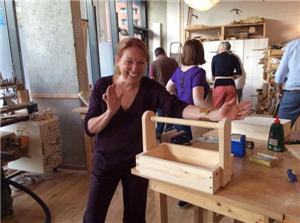
The Goodlife Centre is an example of an increasingly common sight in urban Britain – a social hub where you can bring along products in need of repair and work alongside volunteers to fix it.
“The sharing community is incredibly exciting,” says Winfield-Chislett. “I’ve been collecting contacts for the past three years of people who’ve been isolated but adamant that they wanted to be part of some type of repair revolution. We’re now getting far more joined up.”
Engaging with SMEs
“The sharing community is incredibly exciting,” says Winfield-Chislett. “I’ve been collecting contacts for the past three years of people who’ve been isolated but adamant that they wanted to be part of some type of repair revolution. We’re now getting far more joined up.”
Engaging with SMEs
Repair cafés not only promote the benefits of the circular economy to the individual, Winfield-Chislett also suggests that small companies are increasingly keen to engage with a model that opens new possibilities for business.
“At a recent event, several SMEs spoke about the future of sustainability in their company,” says Winfield-Chislett. “There is a huge potential in micro manufacturing for exploring these ideas. There’s a huge market in products that can be produced that people can add onto. The core product would be a basic unit and then you can modify and add onto it. You would therefore continue to purchase features that could be used with the core unit.”
Collaboration
“At a recent event, several SMEs spoke about the future of sustainability in their company,” says Winfield-Chislett. “There is a huge potential in micro manufacturing for exploring these ideas. There’s a huge market in products that can be produced that people can add onto. The core product would be a basic unit and then you can modify and add onto it. You would therefore continue to purchase features that could be used with the core unit.”
Collaboration
The report, published this month, was co-written by Professor Martin Charter and Scott Keiller. Charter, who is the Director of the Centre for Sustainable Design, suggests that part of the reason for the success of Repair Cafés and Hackerspaces is the combination of learning and community offered by the spaces.
“People are coming together to collaborate. They’re driven by a range of things, such as open sourcing of designs and learning to repair for themselves. On the other hand there’s the wish of people to physically get together.”
The Repair Café Foundation was set up by Martine Postma in the Netherlands in 2010 as a way of allowing people to repair products that would otherwise end up as waste. Since then, the concept has spread across Europe and the US.
“People are coming together to collaborate. They’re driven by a range of things, such as open sourcing of designs and learning to repair for themselves. On the other hand there’s the wish of people to physically get together.”
The Repair Café Foundation was set up by Martine Postma in the Netherlands in 2010 as a way of allowing people to repair products that would otherwise end up as waste. Since then, the concept has spread across Europe and the US.
At its core, the concept of a Repair Café is a physical space for anyone who wishes to learn how to fix their items, but Winfield-Chislett points to the internet as an important catalyst for the growth of this community:
“Sharing fixing solutions online is a great way of showing we can add life to products if we knew how to fix them ourselves,” says Winfield-Chislett. “If we had the confidence or the patience to fix them ourselves.”
Report findings
“Sharing fixing solutions online is a great way of showing we can add life to products if we knew how to fix them ourselves,” says Winfield-Chislett. “If we had the confidence or the patience to fix them ourselves.”
Report findings
The report surveyed 144 named repair cafés across nine countries and 48 Hackerspaces in 18 countries. Asked about the reasons for participating in a repair café, the top three reasons given were: to encourage others to live more sustainably, to provide a valuable service to the community and to be a part of the movement to improve product reparability and longevity. Responding to the same question, participants at Hackerspaces said they wanted to meet others who shared their interests, to be intellectually stimulated and to learn new skills.
The report also draws attention to differences between the two organisations in terms of future approaches to business. While only 15 per cent of repair café members wished to provide space and support for business start-ups, around 40 per cent of hackerSpace members agreed and 22 per cent strongly agreed that they wanted their activities to lead to new business start-ups. However, around 40 per cent of both repair cafe and hackerspace members said they wanted more sponsorship from businesses.
Hackerspaces: experimentation
The report also draws attention to differences between the two organisations in terms of future approaches to business. While only 15 per cent of repair café members wished to provide space and support for business start-ups, around 40 per cent of hackerSpace members agreed and 22 per cent strongly agreed that they wanted their activities to lead to new business start-ups. However, around 40 per cent of both repair cafe and hackerspace members said they wanted more sponsorship from businesses.
Hackerspaces: experimentation
“The main emphasis is on experimentation in hackerspaces,” says Charter, “but they are also modifying products and changing the function of spaces. Contributing to the circular economy isn’t a prime driver for people there but there is repair and modification happening in these organisations which is an interesting finding.”
Hackerspaces are somewhat harder to categorise than repair cafes. Unlike the latter, hackerspaces are infrequently established with the specific aim of addressing sustainability, but through the activities offered they nevertheless engage with the circular economy.
The London Hackspace describes itself as follows: “a social space for people who like to make things: we have a workshop with woodworking and metalworking machinery, extensive electronics equipment, a lasercutter, and many other tools and devices. Additionally we are host to a large social sphere of hackers, makers, scientists and artists, and a growing number of community subgroups that cater to particular interests.”
Recycling and ‘open source’ production
Recycling and ‘open source’ production
The name may suggest an emphasis on coding and software development, and according to the survey these are in fact the most frequent activities undertaken in hackerspaces, but there is a wide range of other ‘hacks’ available. These can cover making electronic devices, art projects and ‘bio-hacking’; an area that focuses on using molecular and synthetic biology. According to the survey the key ethos which binds all these disciplines is ‘open source’, license free peer-produced software and hardware, underpinned by a belief in sharing information. It’s a focus that overlaps with the philosophy of recycling in repair cafés.
Both Charter and Winfield-Chislett noted that the age group tends to be higher in repair cafés than hackerspaces, and that hackerspaces are currently quite male dominated. Both also pointed to the potential of these organisations to transcend the current demographics and become part of a larger shift towards recycling and open source production.
“You can already find around 15 repair cafes in Amsterdam and you’ll see people circulating between them,” said Charter. “They might be volunteers or professionals, for example; electricians, bike fixers or computer repairmen. We’re predicting this may pass from individual cafes into a more complex repair eco-system.”
With the open source ethos of hackerspaces and the continued growth of repair communities, individuals may find themselves less and less likely to abandon damaged products, and small businesses may increasingly look at the circular economy as a model for future business.
Both Charter and Winfield-Chislett noted that the age group tends to be higher in repair cafés than hackerspaces, and that hackerspaces are currently quite male dominated. Both also pointed to the potential of these organisations to transcend the current demographics and become part of a larger shift towards recycling and open source production.
“You can already find around 15 repair cafes in Amsterdam and you’ll see people circulating between them,” said Charter. “They might be volunteers or professionals, for example; electricians, bike fixers or computer repairmen. We’re predicting this may pass from individual cafes into a more complex repair eco-system.”
With the open source ethos of hackerspaces and the continued growth of repair communities, individuals may find themselves less and less likely to abandon damaged products, and small businesses may increasingly look at the circular economy as a model for future business.
Like this content? Please subscribe to our free weekly e-newsletter at the top of the page for more content like this.
Follow us on Twitter.
Related content: