Climate-KIC Journey: the EU school helping to create tomorrow’s green entrepeneurs
15th August 2014
For the past two weeks, graduates from countries covering France to Japan have been working with London’s top universities and businesses to develop ideas that may crack the future battle against climate change. Thomas McMullan reports.
“We’re all here from around the world,” says Teddy Szemberg O’Connor, a PhD at Imperial College studying Fluid Mechanics on a site visit to a community farm in East London. “We’ve all come with our own ideas and threads of information and are trying to connect them together and build a bigger idea out of them.”
O’Connor is among 300 students attending ‘The Journey’, a five-week summer school set up by the EU’s main climate innovation initiative, Climate-KIC, to create tomorrow’s green entrepreneurs. This summer, the initiative, which is now in its fourth year, had around 1100 students apply for places.
The school is just nearing the end of two weeks in London, before setting off for Denmark and Poland. It’s unique set up not only encourages international networking (there are around 30 different nationalities on the course) but also, through sharing of expertise, taps into ideas of a circular economy where resources are shared and waste is turned into useful products.
Connecting together
Connecting together
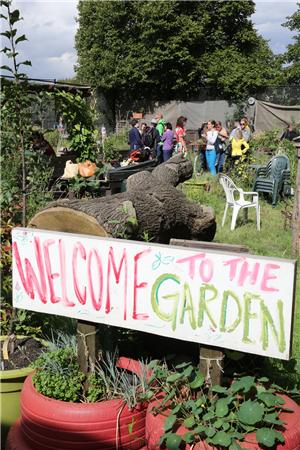
The graduates, who vary from master to PhD level across disciplines as wide ranging as architecture, environmental studies, business and bioenergy, have been visiting sites and events which engage with sustainable innovation, including a product re-use workshop at the Royal School of Art and a community farm at the Poplar Housing and Regeneration Community Association (Harca).
“This is a safe platform to come up with ideas,” says O’Connor. “It’s as if the EU is saying ‘We’ve put a lot of money into PhD students who have advanced technical skills, how can we get them to put those skills to use in industry?’”
Circular model
“This is a safe platform to come up with ideas,” says O’Connor. “It’s as if the EU is saying ‘We’ve put a lot of money into PhD students who have advanced technical skills, how can we get them to put those skills to use in industry?’”
Circular model
The circular nature of the summer school begins to become apparent when looking at the larger picture of Climate-KIC’s model. Once the students have completed The Journey, they are invited to apply for an entrepreneurial pre-incubation programme, The Greenhouse, which sets them on a path to further business development.
“The students spend five weeks coming up with grand ideas, then we give them a month to reflect on their ideas and decide whether they want to take them forward, whether they’re still passionate about them,” says Lisa McElhinney, education administrator for Climate-KIC UK.
“Then the application round opens for them to enter the Greenhouse. We call it an experimental environment where you can keep playing around with your idea, keep playing with your business model, make a prototype, conduct market research, etc. We give them 5000 euros (£3994) of funding to help them do that for up to a year. We also give them professional business coaches so the students get continued support taking their ideas forward.”
The Greenhouse stage in turn opens the possibility for fledgling entrepreneurs to enter Climate-KIC’s Accelerator, a full incubation programme with larger amounts of funding on the table. And yet perhaps just as crucial as the funding are the connections to businesses made during the process of growth.
Green entrepreneurs
“The students spend five weeks coming up with grand ideas, then we give them a month to reflect on their ideas and decide whether they want to take them forward, whether they’re still passionate about them,” says Lisa McElhinney, education administrator for Climate-KIC UK.
“Then the application round opens for them to enter the Greenhouse. We call it an experimental environment where you can keep playing around with your idea, keep playing with your business model, make a prototype, conduct market research, etc. We give them 5000 euros (£3994) of funding to help them do that for up to a year. We also give them professional business coaches so the students get continued support taking their ideas forward.”
The Greenhouse stage in turn opens the possibility for fledgling entrepreneurs to enter Climate-KIC’s Accelerator, a full incubation programme with larger amounts of funding on the table. And yet perhaps just as crucial as the funding are the connections to businesses made during the process of growth.
Green entrepreneurs
One success story is Kate Hofman, a previous member of the summer school who came up with the idea of using disused shipping containers and turning them into aquaponic farms. Through Climate-KIC’s partnership with Poplar Harca, and through growing the idea as a startup through Climate-KIC’s Accelerator, she was able to build her business and set up GrowUp Urban Farms, a company which develops small-scale agricultural production units that combine hydroponics and fish farming. Neatly illustrating a circular model of mutually benefiting parties, Poplar Harca worked with Hofman through the summer school, GrowUp in turn worked with Poplar Harca and this year Poplar Harca are in turn working with a fresh group of graduate students through Climate-KIC.
“Poplar Harca is an affiliate partner of Climate-KIC UK,” explains Catherine Oriel, communications manager for Climate-KIC UK. “We can provide them with various areas of expertise, PhD students, funding. In return they contribute to the summer school. One of the things Climate-KIC does is broker relationships between groups who wouldn’t normally get to meet each other.”
Partnering with industry
“Poplar Harca is an affiliate partner of Climate-KIC UK,” explains Catherine Oriel, communications manager for Climate-KIC UK. “We can provide them with various areas of expertise, PhD students, funding. In return they contribute to the summer school. One of the things Climate-KIC does is broker relationships between groups who wouldn’t normally get to meet each other.”
Partnering with industry
Climate-KIC has around 200 core and affiliate partners spread out over Europe. Around 50 per cent of these are business and around half of these businesses are SMEs – a much higher percentage than sister EU initiatives, such KIC-InnoEnergy.
“If you take our partners, who are sometimes small business and sometimes huge institutions such as Imperial College or the Institute for Sustainability, we use these connections to introduce our start-ups to industry,” says Oriel. “For example, there’s a start-up of ours called Naked Energy which makes solar panels. It developed the panels but needed pilot sites to use them so we introduced it to Sainsbury’s, which is also a partner of ours. It’s an introduction that probably wouldn’t have happened normally. Naked Energy was then able to trial its panels on a proper site.”
Students from the summer school will get a sense of future business possibilities at the Climate-KIC UK Venture Competition, which on Thursday saw nine innovative climate start-ups, including GrowUp Farms, compete to win two prizes of 20,000 euros (£15,988) and a place in the Climate-KIC European final in Valencia.
Ahead of the event, director for Climate-KIC UK, professor Richard Templer, said that eight out of the nine start-ups, which also include peer-to-peer online renewable energy marketplace, Open Utility, and residential heat network, Coheat, have gone on to raise one million euros in funding.
For the graduate students at the start of their journey, these start-ups offer a glimpse into the future; a circular model where the businesses and institutions who have worked with them during the summer may again work with them in years to come.
“If you take our partners, who are sometimes small business and sometimes huge institutions such as Imperial College or the Institute for Sustainability, we use these connections to introduce our start-ups to industry,” says Oriel. “For example, there’s a start-up of ours called Naked Energy which makes solar panels. It developed the panels but needed pilot sites to use them so we introduced it to Sainsbury’s, which is also a partner of ours. It’s an introduction that probably wouldn’t have happened normally. Naked Energy was then able to trial its panels on a proper site.”
Students from the summer school will get a sense of future business possibilities at the Climate-KIC UK Venture Competition, which on Thursday saw nine innovative climate start-ups, including GrowUp Farms, compete to win two prizes of 20,000 euros (£15,988) and a place in the Climate-KIC European final in Valencia.
Ahead of the event, director for Climate-KIC UK, professor Richard Templer, said that eight out of the nine start-ups, which also include peer-to-peer online renewable energy marketplace, Open Utility, and residential heat network, Coheat, have gone on to raise one million euros in funding.
For the graduate students at the start of their journey, these start-ups offer a glimpse into the future; a circular model where the businesses and institutions who have worked with them during the summer may again work with them in years to come.
Like this story? Please subscribe to our free weekly e-newsletter at the top of the page for more content like this.
Follow us on Twitter.
Related content: