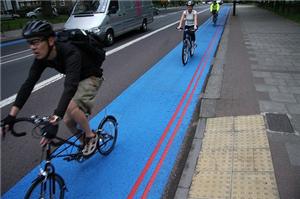
Businesses could boost productivity by encouraging cycling and walking to work
Green business news – by Thomas McMullan
22nd September 2014
Environmental charities and sustainability experts are calling on company bosses to encourage their staff to walk and cycle to work and reap the rewards of a more productive workforce.
The advice to businesses of all sizes comes in the wake of a recent study by health economists at the University of East Anglia (UEA) and the Centre for Diet and Activity Research (CEDAR), which concludes that people who stop driving and start walking or cycling to work benefit from improved mental wellbeing.
Better concentration
Tax breaks for cycling
Like this story? Please subscribe to our free weekly e-newsletter at the top of the page for more content like this.
Better concentration
The study, published last week and entitled ‘Does active commuting improve psychological wellbeing?’ look at studied 18 years of data on almost 18,000 18-65-year-old commuters in Britain, and found that “active commuters felt better able to concentrate and were less under strain than if they travelled by car”. It examined different aspects of psychological health including feelings of worthlessness, unhappiness, sleepless nights, and being unable to face problems.
“The benefits are felt far beyond carbon savings, helping build greater employee engagement, health and wellbeing,” said Steve Malkin, ceo of sustainability certifier, Planet First. “As more people shift to walking and cycling to work it will help improve the air quality in our cities for everyone.”
According to the 2011 census, 67.1 per cent of commuters drive to work compared to 10.9 per cent who walk and 3.1 per cent who cycle. In order to address this imbalance environmental charities are rallying for businesses to promote alternatives to driving that both reduce carbon and benefit employee health.
“Our study shows that the longer people spend commuting in cars, the worse their psychological wellbeing. And correspondingly, people feel better when they have a longer walk to work,” said Adam Martin, lead researcher at UEA.
“Our study shows that the longer people spend commuting in cars, the worse their psychological wellbeing. And correspondingly, people feel better when they have a longer walk to work,” said Adam Martin, lead researcher at UEA.
Ways to encourage walking and cycling
Methods to encourage cycling and walking include providing shower facilities and greater space for bicycle parking. “It’s important to both enable and motivate staff for them to change their travel behaviour,” said Caroline Watson, partner at environmental charity, Global Action Plan. “Installing infrastructure such as showers, lockers and secure bike parking enables business commuters to cycle to work. In addition to this, motivating and inspiring staff can lead to an uptake in cycling.”
Global Action Plan worked with life assurance company Friends Life to encourage cycling to work. “Cyclists uploaded their daily routes to a shared map so everyone could see how many people were cycling in and how far they had come, motivating their colleagues to also take up cycling,” said Watson. “With a combination of these measures, Friends Life increased numbers of staff cycling to work at their Bristol office by nine per cent in just one month.”
Global Action Plan worked with life assurance company Friends Life to encourage cycling to work. “Cyclists uploaded their daily routes to a shared map so everyone could see how many people were cycling in and how far they had come, motivating their colleagues to also take up cycling,” said Watson. “With a combination of these measures, Friends Life increased numbers of staff cycling to work at their Bristol office by nine per cent in just one month.”
Tax breaks for cycling
The average commute to work is 15 kilometres and you can reportedly save six kilograms of carbon by switching from your car to a bicycle. “We highlight that employees and employers receive tax breaks for buying bikes and kit through the business,” points out Malkin. “Grants of up to £1000 are available for businesses to encourage staff to use alternative transport, such as through www.sustainableroutes.co.uk.
“You can also encourage people to change their travel habits by supporting environmental awareness days such as World Car Free Day on September 22 and Walk to Work week. Some posters, snack bars and breakfast raise the profile of your event and incentivise employees to participate.”
Public transport benefits
“You can also encourage people to change their travel habits by supporting environmental awareness days such as World Car Free Day on September 22 and Walk to Work week. Some posters, snack bars and breakfast raise the profile of your event and incentivise employees to participate.”
Public transport benefits
In addition to cycling, the UEA’s survey also found that, surprisingly, public transport is better for people’s wellbeing than driving.
“One surprising finding was that commuters reported feeling better when travelling by public transport, compared to driving,” said Martin. You might think that things like disruption to services or crowds of commuters might have been a cause of considerable stress. But as buses or trains also give people time to relax, read, socialise, and there is usually an associated walk to the bus stop or railway station, it appears to cheer people up.”
“One surprising finding was that commuters reported feeling better when travelling by public transport, compared to driving,” said Martin. You might think that things like disruption to services or crowds of commuters might have been a cause of considerable stress. But as buses or trains also give people time to relax, read, socialise, and there is usually an associated walk to the bus stop or railway station, it appears to cheer people up.”
Like this story? Please subscribe to our free weekly e-newsletter at the top of the page for more content like this.
Follow us on Twitter.
Related content: