Bringing closed loop into the mainstream: HP opens the doors on its pioneering plastics recycling
24th April 2013
In an effort to reduce their environmental footprint and ‘insure’ their businesses against the risks of a resource constrained world, more and more companies are introducing ‘closed loop’ systems into their manufacturing businesses. But one company claims to be doing it on scale not seen before. Louise Bateman reports on Hewlett Packard’s printing cartridge recycling business that has seen it team up with a small, pioneering plastics recycling firm in Montreal, Canada.
From the outside, the Lavergne Group manufacturing plant a few miles outside Montreal is a squat and otherwise nondescript construction. Once inside, though, the décor immediately catches one’s eye. First, there’s the tall, slim, somewhat dated fish tank taking centre stage in the reception area. Second, are the lilac coloured walls in the corridor leading past the offices of this pioneering ‘closed loop’ plastics recycling plant. A quick glance in each of these rooms adds to the impression of a place locked in time: nothing appears to have been ‘thrown away’ for almost half a century.
I’m on the first press tour this French-Canadian manufacturing plant has ever hosted – and it marks an extra special occasion for Lavergne Group because it has been organised by one of the firm’s most prized clients, Hewlett Packard (HP).
For the past 12 years, Lavergne Group has been working with HP’s printing division to help close the loop on the multinational IT company’s ink and laser jet toner cartridge business. It’s been a journey of ups and downs, achievements and setbacks, but ultimately reward for this plastics engineering firm of just 60 staff and its giant corporate client. Since partnering on the closed loop plastic recycling programme, more than half a billion used HP cartridges have been recycled into new ones.
“Just to put this into context, a container of material has left this plant every day for the last year. This is significant volumes,” Dean Miller, programme manager for recycling and recycled content at HP, tells the assembled Canadian and international journalists.
And he adds: “Without [Lavergne Group] we would not be able to talk about this closed loop success. We would likely be talking about HP’s ability to recycle the plastic, but we wouldn’t be talking about our ability to put it back into cartridges. This is one of the best examples I’ve been involved in at HP of good collaboration.”
Closed loop recycling
‘Closed loop’ may not yet be the buzzword in manufacturing, but it soon will be. It’s a production system whereby the waste material within the manufacturing process and at end of life is returned back to that same process for re-use.
It has significant implications for resource efficiency and cutting carbon emissions. There are plenty of examples of where it’s already being successfully applied. InterfaceFLOR, the US carpet manufacturer, has been pioneering closed loop systems to reuse the materials in its carpets, such as the nylon yarn, for some time now. UK retailer M&S, meanwhile, has achieved a number of closed loop projects, including reusing some of its own plastic waste to remake carrier bags and creating a ladies winter coat from recycled cashmere and wool, which had been sourced from unwanted products returned to M&S. In February, sportswear brand PUMA launched its first range of products made using the ‘closed loop’ system of production. And, Coca Cola last year partnered with recycling firm Continuim Recycling in the UK to re-process 140,000 tonnes of mixed plastic bottles per year to be re-used in new Coca-Cola bottles.
But what sets HP’s closed loop initiative apart from others, according to Miller, is the sheer scale of the programme. To date, HP has recycled 776,000 metric tons of electronics and original HP print cartridges around the world. And the company says it aims to almost double this figure to 1.6 million metric tons by the end of 2015.
So how has a small plant in Quebec come to supply the world’ largest technology company?
Innovation and quality are the short answers. Since first developing a process to clean and wash PET bottles in 1984, Lavergne Group has not only extended the range and applications of resins its recycles, but tirelessly focused on making them as high grade, if not higher, as their virgin counterparts. The result is that Lavergne Group products can now be found in cars, the home and the office, including ‘original’ HP printer cartridges – a process known as ‘up-cycling’.
It’s a focus on quality that convinced HP to make the investment into closed loop rather than remanufacturing its cartridges in the first place. The company makes a big point of the fact that it only sells original HP printer cartridges. It points to 2011 research by InfoTrends that shows 90 per cent of ink and toner cartridges sold from remanufacturers will ultimately be thrown away and that, according to a survey commissioned by HP, remanufactured cartridges perform poorly compared to original ones.
Disassembling the cartridges was an innovation in itself for HP and has improved plastic recovery from around 60 per cent to 90 per cent compared to HP’s old system of crushing the cartridges (it has also saved on water and energy). The only downside to this system is the disassembly machines are “very cartridge specific”, says Miller, which means only HP inkjet cartridges are being recycled in this way for the moment.
Stage two involves the collecting and processing of recycled PET bottles, a material which is required to be mixed with the HP plastic cartridges to ensure the new cartridges are of a sufficient high quality grade. This is a process that Lavergne has special expertise in, having developed a unique system to clean PET bottles that has earned the company food grade certification.
Stage three ensures the PET plastics are mixed with the plastic additives in a giant ‘blender’ – one of only two that exist in the world (the other is not used in the recycling sector). This is a huge sealed container that turns on itself for hours at a time blending the materials inside it. Lavergne says this is a critical part of the process and likens it to “mixing a cake”.
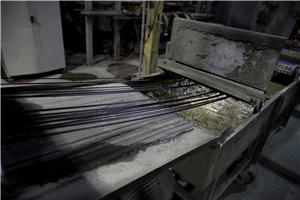
Stage four is the ‘extrusion’ phase, where the mixed plastic particles are turned into strings of plastic (see picture). Its at the end of this phase, that any contaminated plastic is separated from the virgin grade recycled plastic.
Stage five involves a final quality check and shipping.
Environmental benefits
For all this, though, HP has not yet found a way to recover the cost of collecting its used cartridges from customers, a programme called HP Planet which now operates across 67 countries.
But a more pressing problem faces HP. Since producing its first recycled original HP cartridge in 2005, HP’s closed loop programme has grown year on year, until 2011, when the numbers began falling.
“We knew that our portfolio was shifting and for us to continue this growth we had to include the next largest family of inkjet supplies so we were trying to get that onboard by this year so we wouldn’t see this dip but we missed the target,” admits Miller.
Developing this new line of recycled inkjet supplies has meant developing a new recycled resin, this time from polypropylene. HP and Lavergne had been hoping to complete the development phase and have the new programme rolled out within a year and half, but the programme has “hit hurdles” says Miller, and the rollout is now expected by the end of the year.
Then, he says, “we can begin another upwards growth curve.”
HP paid for the cost of attending this press event.
Follow us on Twitter.
Is there a marketing message in all of this? I’m not sure, but it’s certainly helps focus the mind on a problem Jean-Luc Lavergne, the founder of Lavergne Group, has dedicated himself to finding solutions to for almost three decades; namely our mounting rubbish problem and, more especially, the polluting plastic waste we discard.
I’m on the first press tour this French-Canadian manufacturing plant has ever hosted – and it marks an extra special occasion for Lavergne Group because it has been organised by one of the firm’s most prized clients, Hewlett Packard (HP).
For the past 12 years, Lavergne Group has been working with HP’s printing division to help close the loop on the multinational IT company’s ink and laser jet toner cartridge business. It’s been a journey of ups and downs, achievements and setbacks, but ultimately reward for this plastics engineering firm of just 60 staff and its giant corporate client. Since partnering on the closed loop plastic recycling programme, more than half a billion used HP cartridges have been recycled into new ones.
“Just to put this into context, a container of material has left this plant every day for the last year. This is significant volumes,” Dean Miller, programme manager for recycling and recycled content at HP, tells the assembled Canadian and international journalists.
And he adds: “Without [Lavergne Group] we would not be able to talk about this closed loop success. We would likely be talking about HP’s ability to recycle the plastic, but we wouldn’t be talking about our ability to put it back into cartridges. This is one of the best examples I’ve been involved in at HP of good collaboration.”
Closed loop recycling
‘Closed loop’ may not yet be the buzzword in manufacturing, but it soon will be. It’s a production system whereby the waste material within the manufacturing process and at end of life is returned back to that same process for re-use.
It has significant implications for resource efficiency and cutting carbon emissions. There are plenty of examples of where it’s already being successfully applied. InterfaceFLOR, the US carpet manufacturer, has been pioneering closed loop systems to reuse the materials in its carpets, such as the nylon yarn, for some time now. UK retailer M&S, meanwhile, has achieved a number of closed loop projects, including reusing some of its own plastic waste to remake carrier bags and creating a ladies winter coat from recycled cashmere and wool, which had been sourced from unwanted products returned to M&S. In February, sportswear brand PUMA launched its first range of products made using the ‘closed loop’ system of production. And, Coca Cola last year partnered with recycling firm Continuim Recycling in the UK to re-process 140,000 tonnes of mixed plastic bottles per year to be re-used in new Coca-Cola bottles.
But what sets HP’s closed loop initiative apart from others, according to Miller, is the sheer scale of the programme. To date, HP has recycled 776,000 metric tons of electronics and original HP print cartridges around the world. And the company says it aims to almost double this figure to 1.6 million metric tons by the end of 2015.
“Unprecedented innovation”
“This has not only been an unprecedented innovation in terms of getting plastics back into electronic products, but even within the plastics industry it was viewed as a pretty incredible in terms of the scale that HP eventually rolled this out at,” says Miller. “You’ll often read news stories with regards to recycling [innovation], even closed loop efforts, but if you read between the lines and look at the detail, for the most part they are very small scale. What we are talking about here is on a massive production scale.”
“This has not only been an unprecedented innovation in terms of getting plastics back into electronic products, but even within the plastics industry it was viewed as a pretty incredible in terms of the scale that HP eventually rolled this out at,” says Miller. “You’ll often read news stories with regards to recycling [innovation], even closed loop efforts, but if you read between the lines and look at the detail, for the most part they are very small scale. What we are talking about here is on a massive production scale.”
So how has a small plant in Quebec come to supply the world’ largest technology company?
Innovation and quality are the short answers. Since first developing a process to clean and wash PET bottles in 1984, Lavergne Group has not only extended the range and applications of resins its recycles, but tirelessly focused on making them as high grade, if not higher, as their virgin counterparts. The result is that Lavergne Group products can now be found in cars, the home and the office, including ‘original’ HP printer cartridges – a process known as ‘up-cycling’.
It’s a focus on quality that convinced HP to make the investment into closed loop rather than remanufacturing its cartridges in the first place. The company makes a big point of the fact that it only sells original HP printer cartridges. It points to 2011 research by InfoTrends that shows 90 per cent of ink and toner cartridges sold from remanufacturers will ultimately be thrown away and that, according to a survey commissioned by HP, remanufactured cartridges perform poorly compared to original ones.
The secret to Lavergne’s success appears to be a combination of technology, process and value. The company has invested time and money into materials and machinery that is unique to the recycling sector. One of these is the plastic additives ingredients it has developed in order to effectively ‘close the loop’ on the HP’s recycling programme by ensuring the recycled resins fit exactly with the moulding tools and production tools HP has invested millions around the world in for its virgin resins.
Unique process
The manufacturing process contains five stages, beginning with the ‘disassembly’ and ‘rinsing’ of the used HP cartridges, a stage that actually takes place at separate HP plants in the US and Europe.
The manufacturing process contains five stages, beginning with the ‘disassembly’ and ‘rinsing’ of the used HP cartridges, a stage that actually takes place at separate HP plants in the US and Europe.
Disassembling the cartridges was an innovation in itself for HP and has improved plastic recovery from around 60 per cent to 90 per cent compared to HP’s old system of crushing the cartridges (it has also saved on water and energy). The only downside to this system is the disassembly machines are “very cartridge specific”, says Miller, which means only HP inkjet cartridges are being recycled in this way for the moment.
Stage two involves the collecting and processing of recycled PET bottles, a material which is required to be mixed with the HP plastic cartridges to ensure the new cartridges are of a sufficient high quality grade. This is a process that Lavergne has special expertise in, having developed a unique system to clean PET bottles that has earned the company food grade certification.
Stage three ensures the PET plastics are mixed with the plastic additives in a giant ‘blender’ – one of only two that exist in the world (the other is not used in the recycling sector). This is a huge sealed container that turns on itself for hours at a time blending the materials inside it. Lavergne says this is a critical part of the process and likens it to “mixing a cake”.
Stage four is the ‘extrusion’ phase, where the mixed plastic particles are turned into strings of plastic (see picture). Its at the end of this phase, that any contaminated plastic is separated from the virgin grade recycled plastic.
Stage five involves a final quality check and shipping.
Environmental benefits
As well as great products, Lavergne Group pledges to deliver “value where others cannot”. It does this, it says, by “lowering overall system costs by reducing the use of energy, water and raw materials”. It’s a pledge that appears to be born out by the facts. HP says that compared to virgin plastic, the recycled plastic used in HP ink cartridges since 2010 has up to an estimated 33 per cent smaller carbon footprint — even when the impacts associated with collecting, transporting and processing are taken into account. And it also estimates that using recycled plastics reduces total water used in cartridge production by up to 89 per cent.
For all this, though, HP has not yet found a way to recover the cost of collecting its used cartridges from customers, a programme called HP Planet which now operates across 67 countries.
But a more pressing problem faces HP. Since producing its first recycled original HP cartridge in 2005, HP’s closed loop programme has grown year on year, until 2011, when the numbers began falling.
“We knew that our portfolio was shifting and for us to continue this growth we had to include the next largest family of inkjet supplies so we were trying to get that onboard by this year so we wouldn’t see this dip but we missed the target,” admits Miller.
Developing this new line of recycled inkjet supplies has meant developing a new recycled resin, this time from polypropylene. HP and Lavergne had been hoping to complete the development phase and have the new programme rolled out within a year and half, but the programme has “hit hurdles” says Miller, and the rollout is now expected by the end of the year.
Then, he says, “we can begin another upwards growth curve.”
HP paid for the cost of attending this press event.
Like this content? Please subscribe to our free weekly e-newsletter at the top of the page for more content like this.
Related content: