ClimateCare: making carbon finance for sustainable development mainstream
22nd April 2014
This week, ClimateCare won a Queen’s Award for Enterprise in Sustainable Development – the UK’s highest accolade for business success. Robert Stevens, head of UK operations at ClimateCare, talks to Louise Bateman, editor of GreenWise, about the award and the company’s mission to bring sustainable development and carbon finance into the mainstream.
Q. You’ve just been awarded a Queen’s Award for Sustainable Development? What does that mean for ClimateCare?
A. We’ve been lucky enough to win lots of industry awards over the years, but we are really delighted with this as it is the most prestigious award a UK company can win. We hope it will encourage new partners to get in touch. It’s a real validation of the work we’ve been doing, but what we are most excited about is that it’s bringing our work and our message into the mainstream.
Q. To date, you say you have helped reduce over 16.5 million tonnes of carbon dioxide emissions and improve the lives of more than six million people. What does that mean in terms of projects you are delivering on the ground?
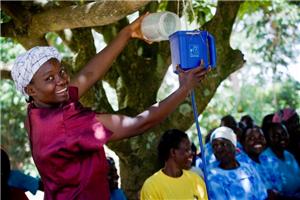
A. One example, is LifeStraw Carbon For Water in Western Kenya, where we’ve delivered 900,000 filters to four million people. Its the first project of its kind to use carbon finance to deliver safe water. Its unique also in terms of its scale and measurement, and in terms of ensuring people are also receiving education on water and sanitation and also on how to use the filters and make sure the filters are usable. Another example is building efficient cook stoves that use less fuel and reduce air pollution and poverty.
Q. Your award comes hot on the heels of two major IPCC’s climate change reports this month – the first showing that consequences of climate change are no longer a risk, but impacting every part of the world – and the second showing that we have the technologies and we can afford to tackle it if the right political will is there. What is your reaction to these findings?
A. For us, it’s about working with forward thinking businesses and organisations and taking this message and understanding forward into the mainstream. The IPCC reports don’t have anything in them that surprises us, but the IPCC has laid out the situation clearly and also demonstrated a path to tackling climate change. It’s about taking it into the mainstream now. We certainly want to present the call to action for businesses and our own experience is that there is an increase in understanding about how to tackle climate change, in the business community in particular, and these reports will help reinforce that understanding.
Q. What do you think needs to happen to get the market working again?
A. An international agreement and framework is what would ultimately be required in the compliance market. On the voluntary side, is about encouraging more businesses to take responsibility for their inevitable carbon footprint and that is why we need to push into the mainstream.
Q. You work with many businesses to help them meet their carbon reduction targets, but isn’t this just an easy way out for companies that should be doing more to cut their emissions in their own operations and their supply chains?
A. As part of our industry group ICROA (International Carbon Reduction and Offset Alliance), we are bound by policies that mean offsetting should always be part of overall carbon reduction strategy and clearly it shouldn’t be used in isolation. Having said that, it’s very important that it is used as part of carbon management strategy because, however good you are at reducing, you will always be left with residual emissions.
Q. Why do you think the businesses you work with now are so keen to deliver social impact?
A.The first thing to say is we always sell our service as a package; our projects all have to reduce emissions to tackle and deliver sustainable development such as poverty alleviation, health improvement. They are not add-ons to carbon offsetting. The reasons why companies are looking to deliver social impact varies from organisation to organisation. For example, with the Cooperative, we are working to bring safe water in their tea farmer communities – for them it’s about taking responsibility for their emissions and ensuring they improve the lives of people in their supply chain.
Q. If you look back to when ClimateCare first started nearly two decades agao, are you were you would expected to have been by now and how positive are you about the future?
A. We’ve been lucky enough to win lots of industry awards over the years, but we are really delighted with this as it is the most prestigious award a UK company can win. We hope it will encourage new partners to get in touch. It’s a real validation of the work we’ve been doing, but what we are most excited about is that it’s bringing our work and our message into the mainstream.
Q. To date, you say you have helped reduce over 16.5 million tonnes of carbon dioxide emissions and improve the lives of more than six million people. What does that mean in terms of projects you are delivering on the ground?
A. One example, is LifeStraw Carbon For Water in Western Kenya, where we’ve delivered 900,000 filters to four million people. Its the first project of its kind to use carbon finance to deliver safe water. Its unique also in terms of its scale and measurement, and in terms of ensuring people are also receiving education on water and sanitation and also on how to use the filters and make sure the filters are usable. Another example is building efficient cook stoves that use less fuel and reduce air pollution and poverty.
Q. Your award comes hot on the heels of two major IPCC’s climate change reports this month – the first showing that consequences of climate change are no longer a risk, but impacting every part of the world – and the second showing that we have the technologies and we can afford to tackle it if the right political will is there. What is your reaction to these findings?
A. For us, it’s about working with forward thinking businesses and organisations and taking this message and understanding forward into the mainstream. The IPCC reports don’t have anything in them that surprises us, but the IPCC has laid out the situation clearly and also demonstrated a path to tackling climate change. It’s about taking it into the mainstream now. We certainly want to present the call to action for businesses and our own experience is that there is an increase in understanding about how to tackle climate change, in the business community in particular, and these reports will help reinforce that understanding.
Q. The Clean Development Mechanism (CDM), the largest mechanism for carbon offsetting in the world, has been badly hit by the crash in the carbon price. How has that affected the work you do?
A. Our carbon finance work is mainly in the voluntary market, although we do some work with CDM. In the voluntary market, the motivations for being involved are different to those in CDM; [partners] want to be involved, they are interested in sustainability and delivering social impact – so the pricing reflects this. In the case of the CDM, we’ve just started work in last six months on the Cook Clean project in Ghana. It’s a CDM project, but is interesting in terms of how it is financed: we’ve secured money for the project upfront from the BioCarbon Fund. The Swedish Energy Agency, which has obligations under the Kyoto Protocol, has agreed to buy carbon credits at a rate that reflects the cost of project [not the CDM carbon price]. This is because the agency has taken a decision to support projects that also deliver social benefit. Its a farsighted approach and its encouraging others to take a similar approach.
A. Our carbon finance work is mainly in the voluntary market, although we do some work with CDM. In the voluntary market, the motivations for being involved are different to those in CDM; [partners] want to be involved, they are interested in sustainability and delivering social impact – so the pricing reflects this. In the case of the CDM, we’ve just started work in last six months on the Cook Clean project in Ghana. It’s a CDM project, but is interesting in terms of how it is financed: we’ve secured money for the project upfront from the BioCarbon Fund. The Swedish Energy Agency, which has obligations under the Kyoto Protocol, has agreed to buy carbon credits at a rate that reflects the cost of project [not the CDM carbon price]. This is because the agency has taken a decision to support projects that also deliver social benefit. Its a farsighted approach and its encouraging others to take a similar approach.
Q. What do you think needs to happen to get the market working again?
A. An international agreement and framework is what would ultimately be required in the compliance market. On the voluntary side, is about encouraging more businesses to take responsibility for their inevitable carbon footprint and that is why we need to push into the mainstream.
Q. You work with many businesses to help them meet their carbon reduction targets, but isn’t this just an easy way out for companies that should be doing more to cut their emissions in their own operations and their supply chains?
A. As part of our industry group ICROA (International Carbon Reduction and Offset Alliance), we are bound by policies that mean offsetting should always be part of overall carbon reduction strategy and clearly it shouldn’t be used in isolation. Having said that, it’s very important that it is used as part of carbon management strategy because, however good you are at reducing, you will always be left with residual emissions.
We are also delivering impacts against other objectives of an organisation – whether that be objectives in engaging with supply chain, communities, and addressing resilience in their supply chains. Its a multi-faceted approach that we take.
Q. Why do you think the businesses you work with now are so keen to deliver social impact?
A.The first thing to say is we always sell our service as a package; our projects all have to reduce emissions to tackle and deliver sustainable development such as poverty alleviation, health improvement. They are not add-ons to carbon offsetting. The reasons why companies are looking to deliver social impact varies from organisation to organisation. For example, with the Cooperative, we are working to bring safe water in their tea farmer communities – for them it’s about taking responsibility for their emissions and ensuring they improve the lives of people in their supply chain.
In more general terms, we are seeing that companies are understanding the risks and opportunities of climate change and sustainable development as part of their core business, not as CSR add-on.
Another point is we are clearly facing a huge challenge and as the IPCC report points out there is not enough government finance to tackle it; the way we approach it is designed to attract and use private finance to tackle these issues.
Q. If you look back to when ClimateCare first started nearly two decades agao, are you were you would expected to have been by now and how positive are you about the future?
A. Its been a difficult journey and I think we all expected to be further along the line of tackling global warming and climate change than we are now. I don’t want to put a negative spin on it, though; the science is becoming more certain and governments who have previously not engaged in climate change debate are now doing so, so we are very hopeful that things are picking up on a global level. We are also definitely seeing and have seen for some time more engagement from the business community in terms of reducing their environmental impact. There is still awful lot to do though.
Follow us on Twitter.
Like this content? Please subscribe to our free weekly e-newsletter at the top of the page for more content like this.
Related content: