
business resource
How to cut your SME’s carbon emissions and resource use in association with the MAYDAY NETWORK
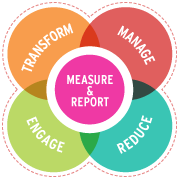 To help small to medium-sized enterprises (SMEs) start their journey towards a sustainable future, The Princes’ Mayday Network recommends businesses progress along the steps of the Mayday Journey:
1. Measure and Report – The first step in your Mayday Journey is to understand what carbon emissions are, how much carbon your business emits and where it is coming from.
2. Manage – To manage your carbon emissions, you can use a five-step approach. This approach covers the key steps for a standard Environmental Management System.
• Make a business-wide commitment that starts at the top
• Set a baseline
• Set objectives and targets
• Set up an action plan
• Monitor and review your carbon management systems.
• Make a business-wide commitment that starts at the top
• Set a baseline
• Set objectives and targets
• Set up an action plan
• Monitor and review your carbon management systems.
3. Reduce – Reduction activities cover four key areas, energy, transport, waste and water and the possibility of buying or generating renewable energy.
Here are some quick tips on how to reduce across all areas:
Energy – Switch off lights when not needed. Make sure exterior lighting is only switched on at night (if required). Changing your lightbulbs will save you energy and money (even if you have fluorescent tubes.)
Energy – Switch off lights when not needed. Make sure exterior lighting is only switched on at night (if required). Changing your lightbulbs will save you energy and money (even if you have fluorescent tubes.)
Transport –. Work at home and telecommute: make it a policy to invest in videoconferencing and other technological solutions that can reduce the amount of employee travel. If businesses could allow their employees to work at home for one day a week the collective reduction in carbon emissions would be huge. This can also have a range of benefits for staff.
Waste – avoid buying non-essential items and items with excess packaging. Reusing items for as long as possible (such as plastic bags) also helps keep waste down. If things have to be disposed of then recycling is a better option than landfill.
Waste – avoid buying non-essential items and items with excess packaging. Reusing items for as long as possible (such as plastic bags) also helps keep waste down. If things have to be disposed of then recycling is a better option than landfill.
Water – Processing and delivering water in the UK accounts for two to three per cent of the country’s total electricity use. Reducing water use does not only reduce carbon emissions and protect supplies to meet current and future demand, it is also an easy way to save money and to reduce risk to your business from water scarcity.
Engage – Extend your actions wider by mobilising your stakeholders; your employees, customers and suppliers, to reduce their carbon emissions.
Employees – Ask your team for ideas for reducing carbon throughout your operations. Incentives such as offering bonuses for eco ideas that save the company money can help speed innovations. You could even go the whole hog and start an internal carbon trading platform like WSP. Involving your team from the start will gain buy-in from them making the long term success of your plans more likely to work out. It can also improve staff morale; people are happy when they feel like they are making a difference. This also increases the chances that staff will implement these kinds of changes at home…which is good for everyone.
Suppliers – Consider targeting your top 10 suppliers by turnover. This often is the easiest way to make large cuts in total supply chain emissions. But remember to look at it from an environmental perspective as well – the products/services with the highest environmental impact may not be in your top spend yet are where you can make the biggest difference.
Customers – By raising awareness of climate change and offering low carbon products and services and other incentives to change behaviours, businesses can extend the reach of their climate change activities and access new of markets.
Transform – Transforming your company to be sustainable ensures it will still be of value tomorrow. Transformation requires adapting to a changing world and innovating for new markets.
For more ways to progress your company along the Mayday Journey visit www.maydaynetwork.com/journey.
