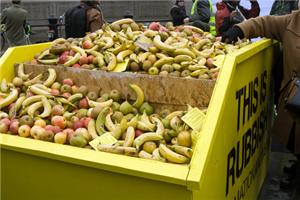
No time to waste: UK firms take action on the food we throw away
5th June 2013
Food and how to save is the theme of today’s World Environmental Day, so what are UK companies doing to reduce the two billion tonnes of food wasted globally a year? Saran Mishra reports.
It’s slowly but surely coming — the year 2050 — when the world’s population will surpass the nine billion mark. Today, global and business leaders are perturbed: how will the world feed its citizens considering the fact that there are enough problems with food security today, 37 years before this estimated ‘doomsday’?
Thus this year, the United Nations Environmental Programme (UNEP) has set a simple theme for World Environmental Day on June 5: Think. Eat. Save. UK companies like Tesco, Asda and Unilever and the Government-backed Waste & Resources Action Programme (WRAP) have already started answering UNEP’s call for food security by putting forward measures to tackle our food waste problem.
Food waste in the UK is a big problem. According to WRAP, households throw away £12 billion of edible food away each year – that equated to around seven million tonnes of food in 2009/10. But the food we throw away in our homes accounts for only 50 per cent of the problem; latest figures from WRAP, reveal that food, drink and packaging waste in the UK supply chain is about 6.6 million tonnes a year and costs £5 billion. And the hospitality and catering sector is throwing away more than 1.5 million tonnes of food every year, which WRAP estimates is costing the industry £724 million a year.
Food insecurity
So who is to be held responsible for our food waste problem?
According to a report by the UK’s Institution of Mechanical Engineers, published earlier this year, as much as half of all the food produced in the world ends up as waste every year – equivalent of two billion tonnes. The report says the blame is all along the food chain, from poor agricultural practices, poor intrastructure and storage facilities to unnecessarily strict sell-by dates, buy-one-get-one free promotional offers and Western consumer demand for cosmetically perfect food.
Supermarkets and food waste
“At Tesco we want to put in more than we take out and we want that to apply to everything we do,” he said.
Tesco is not only committed to cutting waste in its supply chain by building closer relationships with producers and suppliers but also is targeting its customers. By pairing up with various media companies to inform customers and also WRAP, Tesco plans to help consumers waste less food.
Tackling food waste when eating out
“People leave food because portions are too big,” WRAP’s director of design and waste prevention, Dr. Richard Swannell, says. “Consumers want choice across the change; choice that enables us to eat what we want, put together what we want and minimize waste in that process […] so potentially, (restaurants, pubs, cantinas, etc. should be) offering different portion sizes to everybody.”
This week, Unilever revealed a piece of technology that could assist chefs and caterers in their missions to reduce food waste. The free app, ‘Wise up on Waste’, allows chefs and caterers to identify and manage their food waste.
Donating surplus stock
Industry-wide, the movement to reduce food waste is beginning to gain momentum – but not fast enough. British retailers failed last year to meet a voluntary target to reduce the amount of food waste. At the time, WRAP said there had been a “pronounced diversion of waste away from landfill”, but that waste prevention behaviour was not being tackled adequately.
Boycott says that food is marketed to consumers in a manipulative way and that needs to stop if supermarkets are serious about tackling food waste and promoting wellbeing. “Naturally if you walk around a super market today, the sweets are at the eye level of your child and you have to climb down for the porridge that is near the floor, and you naturally end up buying both,” she says.
But the bottom line is simple: there needs to be a reduction in food waste in order to deal with the ever-growing population of the world.
“Currently we throw away billions of tonnes of food […] one of the ways we can tackle this challenge going forward and indeed grow as a sector is by reducing food waste,” Swannell says.
Follow us on Twitter.
Thus this year, the United Nations Environmental Programme (UNEP) has set a simple theme for World Environmental Day on June 5: Think. Eat. Save. UK companies like Tesco, Asda and Unilever and the Government-backed Waste & Resources Action Programme (WRAP) have already started answering UNEP’s call for food security by putting forward measures to tackle our food waste problem.
Food waste in the UK is a big problem. According to WRAP, households throw away £12 billion of edible food away each year – that equated to around seven million tonnes of food in 2009/10. But the food we throw away in our homes accounts for only 50 per cent of the problem; latest figures from WRAP, reveal that food, drink and packaging waste in the UK supply chain is about 6.6 million tonnes a year and costs £5 billion. And the hospitality and catering sector is throwing away more than 1.5 million tonnes of food every year, which WRAP estimates is costing the industry £724 million a year.
Food insecurity
For a country that imports nearly 40 per cent of its food, UK food waste has wider implications. Food experts warn that staples foods could more double in price by 2050 as a result of climate change that will change the way the world farms.
Warmer temperatures have already devastated crops in the United States — a country that wastes nearly 40 per cent of the food it produces and threw away almost $180 billion of food in 2012. The UK has already been hit by food price shocks, such as in the mid-2008 when UK food prices rose about 8.3 per cent from the start of the year.
So who is to be held responsible for our food waste problem?
According to a report by the UK’s Institution of Mechanical Engineers, published earlier this year, as much as half of all the food produced in the world ends up as waste every year – equivalent of two billion tonnes. The report says the blame is all along the food chain, from poor agricultural practices, poor intrastructure and storage facilities to unnecessarily strict sell-by dates, buy-one-get-one free promotional offers and Western consumer demand for cosmetically perfect food.
Supermarkets and food waste
But according to, Rosie Boycott, chairperson of the London Food Board, it is the supermarkets that must take the greatest responsibility. “Don’t pass your waste up the line to your manufacturer who moves it down the line to me, start dealing with it yourself,” Boycott said yesterday at event on tackling food waste hosted by Unilever.
Some companies are taking notice. Tesco, the multinational supermarket chain, announced a major programme to tackle global food waste last week, in which its ceo Phillip Clarke, expressed a willingness to sell less if it meant combating the problem.
“At Tesco we want to put in more than we take out and we want that to apply to everything we do,” he said.
Tesco is not only committed to cutting waste in its supply chain by building closer relationships with producers and suppliers but also is targeting its customers. By pairing up with various media companies to inform customers and also WRAP, Tesco plans to help consumers waste less food.
There are other contributors to this effort. Love Food Hate Waste is a campaign that raises awareness with consumers about the environmental and economic effects of food waste. It further provides them with tips and recipes on how to cut down food waste in the household by adhering to simple practices.
Tackling food waste when eating out
According to a newly published consumer survey on food waste when eating out, WRAP has found that consumers want more choice about portion sizes.
“People leave food because portions are too big,” WRAP’s director of design and waste prevention, Dr. Richard Swannell, says. “Consumers want choice across the change; choice that enables us to eat what we want, put together what we want and minimize waste in that process […] so potentially, (restaurants, pubs, cantinas, etc. should be) offering different portion sizes to everybody.”
This week, Unilever revealed a piece of technology that could assist chefs and caterers in their missions to reduce food waste. The free app, ‘Wise up on Waste’, allows chefs and caterers to identify and manage their food waste.
Donating surplus stock
Advances in technology could be the key to solving the food waste problem globally. But while the problem persists, Asda, the UK’s second largest supermarket chain, has come up with another solution: it has promised to donate all of its surplus stock from its supply chain to 910 charities. This initiative will provide 3.6 million meals every year across the UK and cut back on waste in the supply chain.
Industry-wide, the movement to reduce food waste is beginning to gain momentum – but not fast enough. British retailers failed last year to meet a voluntary target to reduce the amount of food waste. At the time, WRAP said there had been a “pronounced diversion of waste away from landfill”, but that waste prevention behaviour was not being tackled adequately.
Boycott says that food is marketed to consumers in a manipulative way and that needs to stop if supermarkets are serious about tackling food waste and promoting wellbeing. “Naturally if you walk around a super market today, the sweets are at the eye level of your child and you have to climb down for the porridge that is near the floor, and you naturally end up buying both,” she says.
But the bottom line is simple: there needs to be a reduction in food waste in order to deal with the ever-growing population of the world.
“Currently we throw away billions of tonnes of food […] one of the ways we can tackle this challenge going forward and indeed grow as a sector is by reducing food waste,” Swannell says.
Additional reporting by Louise Bateman.
Like this content? Please subscribe to our free weekly e-newsletter at the top of the page for more content like this.
Related content: