From coal mine to wind farm: how the Oakdale onshore wind project is connecting to business growth
10th June 2014
Just as a rail-road brings growth to communities, the Caerphilly County Borough Council in Wales has high hopes that two new wind turbines built on a former colliery – now a business park – will bring jobs and growth to the area. Thomas McMullan reports.
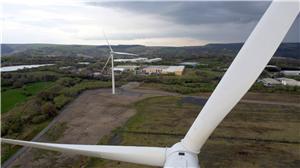
The white wings turn above the old coal pits. Close to the Welsh village of Oakdale, Caerphilly, two wind turbines have been built on the site of an old coal mine; two turbines which represent a new ethos towards energy and business.
One hundred years ago Oakdale was a ‘model village’ for the coal industry. Today it could prove to be a model village once again. When a rail-road is built through a small town it brings growth, and an innovative scheme could similarly see the wind farm becoming a major source of attraction for businesses.
Tackling rising business energy costs
One hundred years ago Oakdale was a ‘model village’ for the coal industry. Today it could prove to be a model village once again. When a rail-road is built through a small town it brings growth, and an innovative scheme could similarly see the wind farm becoming a major source of attraction for businesses.
The Oakdale Business Park, built on the former colliery, houses companies such as General Dynamics. It has already attracted major inward investment projects and is expected to deliver 5,000 jobs into the local economy. As part of this plan it is hoping to capitalise on a pioneering scheme that sees part of the power generated by the two turbines feed directly into the site.
The Oakdale Business Park Wind Energy project opened last week and is the first wind farm to be approved by a local authority in Wales. It comes at a critical time politically for the onshore wind industry. Communities Secretary Eric Pickles has turned down 10 out of 12 applications to build onshore wind farms in the past year and the Tories are promising a moratorium on future onshore wind farms from 2020.
Tackling rising business energy costs
So could the park – and its promise to bring down business energy costs – hold the answer for future UK onshore wind farms?
In a ministerial statement, Pickles highlighted that the planning system did not always reflect the wishes of local communities: “Some local communities have genuine concerns that when it comes to wind farms insufficient weight is being given to environmental considerations like landscape, heritage and local amenity. Meeting our energy goals should not be used to justify the wrong development in the wrong location.”
Indeed, not all local authorities have shared the same keenness towards the prospect of wind farms as Oakdale has. In 2012, Melton Borough Council turned down plans for nine turbines on land near Asfordby. In its statement the council cited the turbines’ visibility as a reason for the block: “The development would constitute a prominent feature in the open countryside which would fail to protect or enhance its distinctive local character and is not capable of mitigation or adequate compensation.”
While the Asfordby site showed the shift towards decentralisation in the planning process could reopen the argument against wind farms on localised aesthetic grounds, Oakdale has shown what is possible when a local authority gets behind the financial and energy benefits brought through collaboration.
Welsh Minister for Natural Resources and Food, Alun Davies, says: “I am determined that we will work innovatively and collaboratively to maximise the long term economic benefits of that resource to Wales and to deliver my ambitions around green growth.”
“The businesses here will be able to use some of the energy generated,” says Roger Evan’s, head of Oakdale and Penmaen Community Partnership. “That means they’ll be able to expand. Expansion means more jobs and that’s the bottom line for us; more jobs.”
“It’s one of the big benefits for the project,” adds Jerry Sturman, regional manager for Partnership for Renewables, who are responsible for developing the project. “We are actively pushing to connect the power to the park as there are local benefits, principally because you don’t have to run power through an external grid to get that energy. You can take it directly. You can save money on the cost of transmission and distribution.”
“It’s one of the big benefits for the project,” adds Jerry Sturman, regional manager for Partnership for Renewables, who are responsible for developing the project. “We are actively pushing to connect the power to the park as there are local benefits, principally because you don’t have to run power through an external grid to get that energy. You can take it directly. You can save money on the cost of transmission and distribution.”
The scheme comes at a time when businesses are facing a surge in energy bills. In 2012-13, businesses saw their gas prices and electricity prices increase by an average of 12 per cent and 13 per cent respectively, according to energy saving experts Make It Cheaper. And lower energy bills are nowhere in sight for businesses. Analysis by the Department of Energy and Climate Change conducted in 2011 estimated energy and climate policies will on average add 19 per cent onto the bill of a UK business with a medium-sized energy consumption by 2020 – and 28 per cent by 2030.
Community benefit
Aside from energy prices, the turbines represent a number of other benefits. As well as paying rent to the council for use of the site, Partnerships for Renewables will provide a community benefit package of £10,000 per year, index-linked for the lifetime of the wind farm, to fund projects that will have a social, economic or environmental benefit. This co-operative attitude could mark a crucial development in the attitude to onshore wind, where instead of solely ticking a green-energy requirement there is an almost collaborative sense of mutual gain.
“On 5th October 2012, one rainy day, we came down to the council chamber in Caerphilly,” says Sturman. “We had five minutes. The chair said to the council, “Right you’ve read the report, what do you think?” No-one said very much. The chair said in that case he’d take it to a vote and everyone put their hand up. I’ve never experienced that in 20 years of working in this industry.”
“Memorial to the past”
“On 5th October 2012, one rainy day, we came down to the council chamber in Caerphilly,” says Sturman. “We had five minutes. The chair said to the council, “Right you’ve read the report, what do you think?” No-one said very much. The chair said in that case he’d take it to a vote and everyone put their hand up. I’ve never experienced that in 20 years of working in this industry.”
“Memorial to the past”
The reasons for this acceptance towards the farm seems to be twofold, linked to both employment and heritage. The Tredegar Iron and Coal Company set up collieries in the Oakdale area at the beginning of the 20th century, building the village to house almost 2,000 workers. When the pits closed in 1989 the area faced rising unemployment.
“The jobs went with nothing to replace them,” says Evans. “That’s why this site and several more sites in the area were set aside for industry, but they remained empty for 20 years. Now the wind farms have come and we have a chance to be self-sufficient. It’s also important that the turbines produce energy without the human cost we faced with the pits. This site is a memorial to the past.”
Political controversy
“The jobs went with nothing to replace them,” says Evans. “That’s why this site and several more sites in the area were set aside for industry, but they remained empty for 20 years. Now the wind farms have come and we have a chance to be self-sufficient. It’s also important that the turbines produce energy without the human cost we faced with the pits. This site is a memorial to the past.”
Political controversy
As well as signifying an important regional decision, the timing of the opening comes at a difficult moment for onshore wind in the UK. The percentage of onshore planning proposals rejected in the UK jumped from 25-29 per cent in 2009-12 to 41 per cent in 2013 and the Conservative Party has decided to drop subsidies for new onshore wind turbines if elected with an overall majority in 2015.
In a ministerial statement, Pickles highlighted that the planning system did not always reflect the wishes of local communities: “Some local communities have genuine concerns that when it comes to wind farms insufficient weight is being given to environmental considerations like landscape, heritage and local amenity. Meeting our energy goals should not be used to justify the wrong development in the wrong location.”
Indeed, not all local authorities have shared the same keenness towards the prospect of wind farms as Oakdale has. In 2012, Melton Borough Council turned down plans for nine turbines on land near Asfordby. In its statement the council cited the turbines’ visibility as a reason for the block: “The development would constitute a prominent feature in the open countryside which would fail to protect or enhance its distinctive local character and is not capable of mitigation or adequate compensation.”
While the Asfordby site showed the shift towards decentralisation in the planning process could reopen the argument against wind farms on localised aesthetic grounds, Oakdale has shown what is possible when a local authority gets behind the financial and energy benefits brought through collaboration.
Welsh Minister for Natural Resources and Food, Alun Davies, says: “I am determined that we will work innovatively and collaboratively to maximise the long term economic benefits of that resource to Wales and to deliver my ambitions around green growth.”
“Tough environment”
Stephen Ainger, ceo of Partnerships for Renewables, admits these are tough times for the onshore wind industry but is adamant that the sector has a future:”It’s a very tough environment; the fact that the carbon price regime is changing, the fact that political support from one of the parties is being withdrawn, but we have an awful lot of projects in Scotland and we have quite a few projects in England. We’re surviving. I think that the fundamentals will out eventually. The fact that onshore-based wind is the cheapest source of renewable energy will bear fruit. This is a long-term business.”
Pushing for wind farms on the basis of power-to-homes may not be justification enough to develop new wind farms, but the attitude shown at Oakdale suggests a model where sustainable energy is crucially connected to the growth of businesses. With schemes such as diverting a portion of the created energy directly into local businesses, wind turbines may be seen not only as a sources of energy but also as engines of progress.
Like this content? Please subscribe to our free weekly e-newsletter at the top of the page for more content like this.
Follow us on Twitter.
Related content: