Ecotricity’s Searaser passes first wave tank test
Green innovation news – by Louise Bateman
27th October 2014
A novel wave power device backed by green energy company Ecotricity has successfully completed first stage testing, it was announced today.
Searaser, which is being developed at Plymouth University, does not generate electricity out at sea like other wave devices, but instead uses the motion of the ocean swell to pump seawater through an onshore generator. This gives it the potential to produce electricity at a lower cost than any other device, including gas turbines and onshore wind, according Ecotricity, which became involved in the project 18 months ago.
Low cost energy
Low cost energy
“This week’s wave tank testing was carried out to validate the extensive computer modelling we’ve been undertaking,” said its British inventor Alvin Smith. “We’ve put Searaser through the most extreme testing regime […] and it’s passed every challenge.”
Ecotricity has drawn up figures that predicts the cost of Searaser to be just two pence per kilowatt hour (p/kWh), compared to existing technologies such as natural gas turbines, for example, which according to Government figures. are between eight and 11 p/kWh, and 9.4 p/kWh for onshore wind.
Based on current estimates, power from waves and tides could potentially meet 15-20 per cent of the UK’s electricity demand by 2050 and UK companies are currently leading the world in developing marine energy.
But most existing wave technologies generate electricity in the sea itself, which brings with it more expensive in the manufacture and maintenance of them because sea and electricity don’t mix.
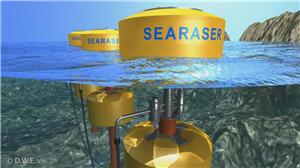
The Searaser works by pumping seawater using a vertical piston between two buoys – one on the surface of the water, the other suspended underwater and tethered to a weight on the seabed. As the ocean swell moves the buoys up-and-down, the piston works like a bicycle pump to send volumes of pressurised seawater through a pipe to an onshore turbine to produce electricity.
‘Seamills’
Ecotricity has drawn up figures that predicts the cost of Searaser to be just two pence per kilowatt hour (p/kWh), compared to existing technologies such as natural gas turbines, for example, which according to Government figures. are between eight and 11 p/kWh, and 9.4 p/kWh for onshore wind.
Based on current estimates, power from waves and tides could potentially meet 15-20 per cent of the UK’s electricity demand by 2050 and UK companies are currently leading the world in developing marine energy.
But most existing wave technologies generate electricity in the sea itself, which brings with it more expensive in the manufacture and maintenance of them because sea and electricity don’t mix.
The Searaser works by pumping seawater using a vertical piston between two buoys – one on the surface of the water, the other suspended underwater and tethered to a weight on the seabed. As the ocean swell moves the buoys up-and-down, the piston works like a bicycle pump to send volumes of pressurised seawater through a pipe to an onshore turbine to produce electricity.
‘Seamills’
Ecotricity says this opens up the option for Searaser units to be used to supply energy on-demand, thus overcoming the problem of supplying intermittent electricity to the National Grid.
“We believe these ‘Seamills’ have the potential to produce a significant amount of the electricity that Britain needs, from a clean indigenous source and in a more controllable manner than currently possible,” said Dale Vince, founder of Ecotricity.
Vince said he hoped to have a full scale prototype in the ocean “in the next 12 months or so”. The first commercial array of ‘Searasers’ could be producing electricity “within a few years” he added.
Searaser is being tested at Plymouth University’s CoastLAB wave tank. Marine energy consultant DNV GL Group, formerly Garrad Hasan, is assisting testing the projects.
“We believe these ‘Seamills’ have the potential to produce a significant amount of the electricity that Britain needs, from a clean indigenous source and in a more controllable manner than currently possible,” said Dale Vince, founder of Ecotricity.
Vince said he hoped to have a full scale prototype in the ocean “in the next 12 months or so”. The first commercial array of ‘Searasers’ could be producing electricity “within a few years” he added.
Searaser is being tested at Plymouth University’s CoastLAB wave tank. Marine energy consultant DNV GL Group, formerly Garrad Hasan, is assisting testing the projects.
Like this story? Please subscribe to our free weekly e-newsletter at the top of the page for more content like this.
Follow us on Twitter.
Related content: