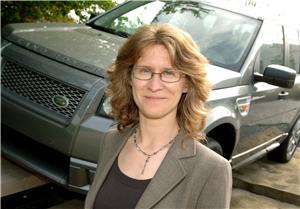
Driving sustainability forward: Jaguar Land Rover’s Fran Leedham
1st June 2011
Louise Bateman talks to Fran Leedham, head of Sustainability at Jaguar Land Rover, about the company’s progress and challenges on sustainability reporting.
Q.You recently published your latest sustainability report and you’ve just moved to report on sustainability across the whole Jaguar Land Rover group, rather than across the two car brands. Why?
We probably were in that position, but we’ve definitely moved into a much more positive position in terms of sustainability.
Q. One of the highlights of the report is an £800 million investment into sustainable technology. How important is it, as a UK manufacturer, to be doing this?
Q. Your goals on operational emissions are across emissions, waste and water, which are all three of the key performance indicators set out in Government guidance. Is this the first time you’ve done this?
A. The data we show and report we’ve been doing since 2002, probably before then. We have data and records since we got ISO 14001 in 1998. That drives our commitment to continue environmental improvement.
Q. Can you tell me more about how you are managing your waste?
A. It is about understanding our waste steams. It use to be that waste all went out in the same place and was a cost to our business. Now, we put a lot of effort into segregation [and] designing out waste is one of our aspirations.
We are testing ‘phase change plasterboard’ at our dealer training centre. It moves from solid to liquid and absorbs and releases heat. We’ve also got special reflective panelling on the front of the building, which looks like a normal industrial building, but it has a corrugated design [to enable] airflow.
Q. What is your opinion on carbon reporting – should it be made mandatory and if so which option would you prefer under those being proposed by Defra?
Q. PUMA has just launched what it describes as a first – an environmental P&L account? What is your view of that and when do you think Jaguar Land Rover will be able to put a price tag on the environmental cost of its products and operations?
Q. What about Life Cycle Assessments (LCAs) – their use is growing rapidly. Are they something Jaguar Land Rover is employing yet and, if so, how and on what?
A.The company obviously operates as one company, but has two distinct brands. We felt it appropriate to communicate sustainability as one. It makes reporting metrics a lot easier because that is the way the company is managed and operated.
Q. Has the Government’s Carbon Reduction Commitment (CRC) Energy Efficiency Scheme been a driver for the change?
A. The CRC wasn’t a driver for us. We are already regulated for carbon emissions through the Climate Change Levy, [so the CRC] was not a driver for producing a combined report.
Q. Jaguar Land Rover has just come through one of its toughest times due to the recession – how has that affected its sustainability strategy and ambitions?
A. In terms of focus, we didn’t lose it or stop doing it.
One of the benefits about sustainability, if positioned correctly, is environmental efficiency. Recessions hit a lot of companies, but by having a solid foundation for managing sustainability and environmental impact, we had a lot of efficiencies built in.
Q.Your Sustainability Report for 2009/10 highlights a lot of your environmental achievements, but interestingly, when talking about the three passions that drive Jaguar Land Rover’s corporate positioning in his introduction to the report, ceo, Dr. Ralph Speth puts ‘environmental innovation’ at number three – below ‘designing great products’ and ‘creating outstanding experiences for customers’ . Doesn’t this show that it’s still not at the heart of everything you do?
A. [The list] is not ordered in terms of importance. [If you were to look at it] in a pyramid, [it would show] a high performance company with two brands and three passions; the order is not indicative of their importance.
We probably were in that position, but we’ve definitely moved into a much more positive position in terms of sustainability.
Q. One of the highlights of the report is an £800 million investment into sustainable technology. How important is it, as a UK manufacturer, to be doing this?
A. It’s important for us, being a UK manufacturer, but also to create a competitive advantage, so we deliver what customers want and for broader social gains.
Q. Your goals for tailpipe emissions are impressive, but isn’t this just what is being directed by Europe? Would you be doing this if you didn’t have to?
A. We would be doing it if it were voluntary. It goes back to being competitive and cost of ownership. Customers are very discerning and equally we are in a world of increased scarcity and oil prices [are rising]. We need to reduce tailpipe emissions and reduce our use of natural resources. It is beyond legislation.
Q. Your goals on operational emissions are across emissions, waste and water, which are all three of the key performance indicators set out in Government guidance. Is this the first time you’ve done this?
A. The data we show and report we’ve been doing since 2002, probably before then. We have data and records since we got ISO 14001 in 1998. That drives our commitment to continue environmental improvement.
Q. Can you tell me more about how you are managing your waste?
A. It is about understanding our waste steams. It use to be that waste all went out in the same place and was a cost to our business. Now, we put a lot of effort into segregation [and] designing out waste is one of our aspirations.
Q. What about water?
A. For us it’s a resource that we have to use very carefully. We’ve made very good progress in how we wash vehicles [and] we have a grey water recycling scheme at our Technical Academy in Warwickshire. It is a showpiece and working very well.
Q. What other technologies are you testing?
A. We are looking at opportunities for wind or solar. We felt solar was a good opportunity, but the changes to the Feed-in Tariff could affect its commercial viability. We are also looking at ground source heat pumps and partnering up with other companies to share technology, such as anaerobic digestion.
We are testing ‘phase change plasterboard’ at our dealer training centre. It moves from solid to liquid and absorbs and releases heat. We’ve also got special reflective panelling on the front of the building, which looks like a normal industrial building, but it has a corrugated design [to enable] airflow.
Q. What is your opinion on carbon reporting – should it be made mandatory and if so which option would you prefer under those being proposed by Defra?
A. We’ve made a decision to report our carbon through the Carbon Disclosure Project – we’ve done that for two or three years.
With all of these things success is in the detail. It’s difficult to draw a conclusion on whether it should be voluntary or mandatory. There are lessons to be learnt with the CRC and it is important there is due consultation.
Q. What about the CRC – what is your view about it being turned into a carbon tax?
A. I think it is very unfortunate that a programme that was set up to have an incentive has had that taken away. We [at Jaguar Land Rover] are already regulated, we are used to carbon regulation, but for companies where this is their first experience […] an incentive scheme would have been better.
Q. PUMA has just launched what it describes as a first – an environmental P&L account? What is your view of that and when do you think Jaguar Land Rover will be able to put a price tag on the environmental cost of its products and operations?
A. I shall look at what PUMA has done. I guess the scale of complexity [in our supply chain ] – 15,000 different components in our vehicles with complex electronics and motors – makes it more difficult for us to do. PUMA probably has less complexity in its products.
Q. What about Life Cycle Assessments (LCAs) – their use is growing rapidly. Are they something Jaguar Land Rover is employing yet and, if so, how and on what?
A. We are using LCA methodology on two of our cars, the Jaguar XJ and the new Range Rover Evoque. Each one takes five or six months to get data and analyse and we have to have data to compare it with. All of this, is so we can understand where we can prioritise our action, so we can tackle it in a phased approach.
Q. When do you think you’ll be using them across all of your products?
A. In five to 10 years time, I think it will be mature enough to have value. It’s got to be, if you don’t have something of value then that is very risky. LCA is not without its flaws. LCA is a very good tool [to understand your environmental impact], but it has to come with a caution: it is only as good as data you start with.
Like this content? Please subscribe to our free weekly e-newsletter at the top of the page for more content like this.
Related content:
Related links:
www.landrover.com