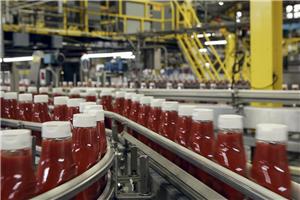
Cars made of tomatoes: Heinz and Ford ink bio-plastics partnership
Green innovation news – by Thomas McMullan
10th June 2014
The union between car and tomato may not be the first thing to come to mind when envisioning the avant-garde of transport, but a new partnership today announced between car conglomerate Ford and food giant Heinz suggests an imminent breakthrough for vehicle manufacturing using sustainable bio-plastics.
Researchers at both Ford and Heinz are currently investigating the application of tomato fibres in developing composite materials for use in car parts.
“We are exploring whether this food processing by-product makes sense for an automotive application,” said Ellen Lee, plastics research technical specialist for Ford. “Our goal is to develop a strong, lightweight material that meets our vehicle requirements, while at the same time reducing our overall environmental impact.”
‘Circular economy’
“We are exploring whether this food processing by-product makes sense for an automotive application,” said Ellen Lee, plastics research technical specialist for Ford. “Our goal is to develop a strong, lightweight material that meets our vehicle requirements, while at the same time reducing our overall environmental impact.”
‘Circular economy’
The pioneering collaboration is a first for Heinz and Ford and further evidence of the growing ‘circular economy’.
The circular economy, set in opposition to the current disposable nature of many manufactured goods, emphasises the use and reuse of a product’s components. A recent report, published in Davos by the World Economic Forum (WEF), in partnership with the Ellen MacArthur Foundation and McKinsey, highlighted in January this year the prospect of this new business model generating $1 trillion (£0.6 trillion) in annual savings by 2025 and creating 100,000 new jobs within five years.
Heinz tomato ketchup byproducts
Heinz tomato ketchup byproducts
The Heinz/Ford partnership will use byproducts from the manufacturing process of Heinz tomato ketchup – largely tomato peels, stems and seeds – to help make the wiring brackets or storage bins in a Ford car.
“We are delighted that the technology has been validated,” said Vidhu Nagpal, associate director, packaging R&D for Heinz. “Although we are in the very early stages of research, and many questions remain, we are excited about the possibilities this could produce for both Heinz and Ford, and the advancement of sustainable 100 per cent plant-based plastics.”
The research forms part of Ford’s global sustainability strategy to lessen its environmental footprint; a strategy which has also seen the company invest in cellulose fiber-reinforced console components and soy foam seat cushions and head restrains.
“We are delighted that the technology has been validated,” said Vidhu Nagpal, associate director, packaging R&D for Heinz. “Although we are in the very early stages of research, and many questions remain, we are excited about the possibilities this could produce for both Heinz and Ford, and the advancement of sustainable 100 per cent plant-based plastics.”
The research forms part of Ford’s global sustainability strategy to lessen its environmental footprint; a strategy which has also seen the company invest in cellulose fiber-reinforced console components and soy foam seat cushions and head restrains.
Like this content? Please subscribe to our free weekly e-newsletter at the top of the page for more content like this.
Follow us on Twitter.
Related content: